
LUSTRINA JET · Aircraft & comfort
Sleeping on a Private Jet: Seats, Berths and Cabin Layout
Sleeping on a private jet depends on the actual berth arrangement, usable dimensions and flight schedule, not simply the aircraft’s passenger capacity.
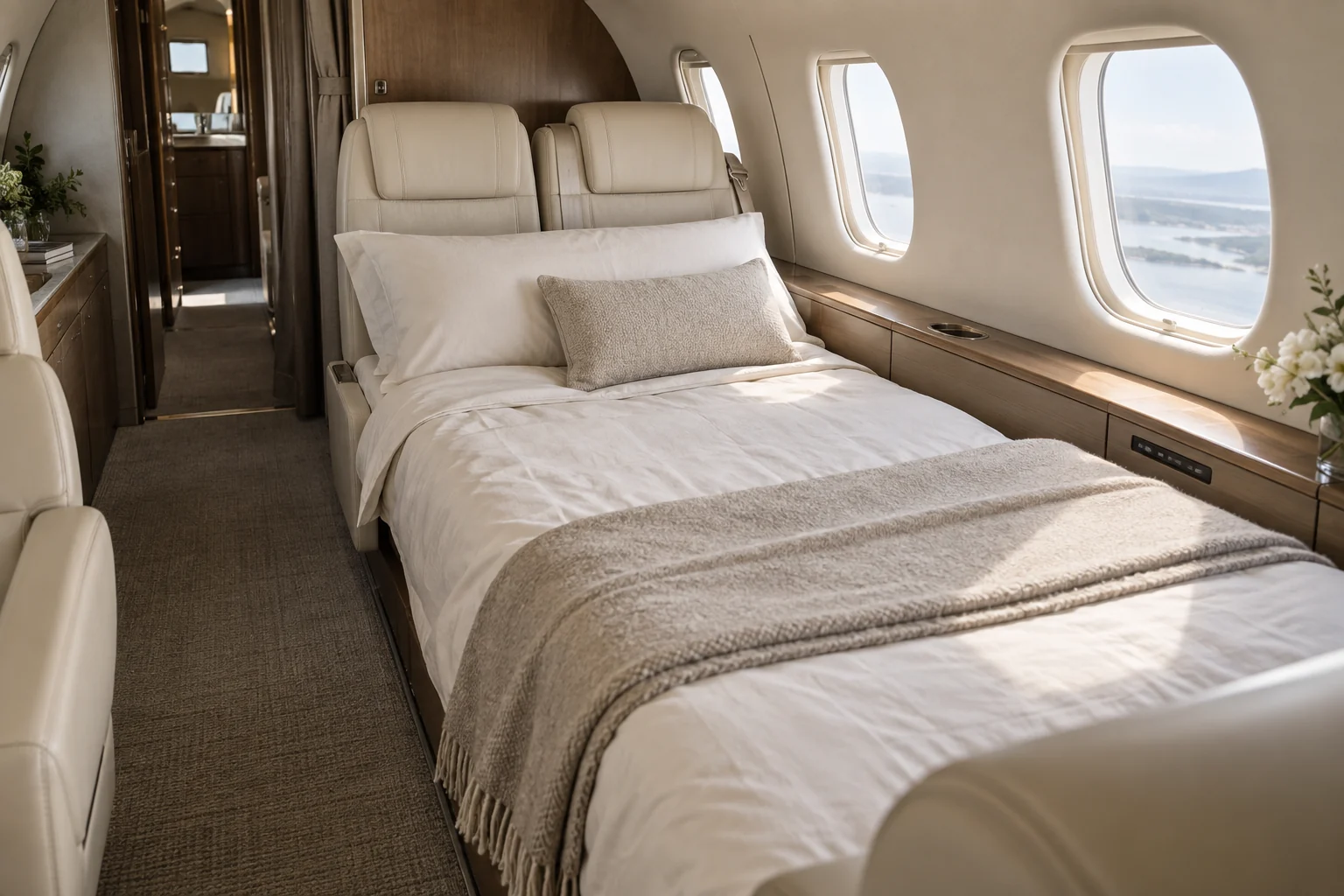
An aircraft advertised for eight passengers may not offer eight places to lie flat. A large cabin can also have a layout that suits a meeting better than overnight rest. Before paying for more space, establish how you intend to use it.
Ask how many people can sleep at once
Separate the certified passenger seating arrangement from the proposed sleeping layout. Seats may recline, pairs may convert into a berth, and a divan may provide another surface. Those arrangements differ in width, length, privacy and the number of people they accommodate.
Ask the operator for the sleeping plan of the actual aircraft. A model-level drawing can help, but it does not establish the interior of every aircraft in that fleet. Use cabin comparison to narrow the search, then confirm the offered configuration.
State the number of adults and children who need to rest at the same time. If one person needs a wider or longer surface, give the relevant requirement. Avoid accepting “sleeps four” without understanding what those four positions look like.
Check usable dimensions and access
Ask for the approximate usable length and width of each sleeping surface, not only the cabin dimensions. Determine whether the berth uses adjacent seats or a separate room and whether another passenger must move to create it.
Think about access to the toilet, aisle and luggage. A sleeping layout that works for one passenger may be awkward when others want to move around. Someone sleeping on a converted seating area may also share the main cabin’s light and conversation.
If privacy is important, ask what separates the space: a door, curtain, partition or simply distance. Do not interpret a photograph taken from a flattering angle as evidence of a separate bedroom.
A berth is not an unrestricted place to remain
The crew decides when the sleeping arrangement can be used under the aircraft’s approved procedures. Passengers must follow instructions for taxi, take-off, landing and other relevant phases or conditions. Do not assume that lying flat removes the need for an approved restraint arrangement.
Ask how the cabin transitions between seating and sleeping and when the crew expects to do it. A flight may leave less uninterrupted rest time than its total duration suggests, particularly with meal service or a technical stop.
For children, check the specific restraint and seating requirements separately. A broad sofa or a parent’s sleeping space does not automatically provide a suitable arrangement for a child. See our guide to flying with children.
Bedding and service need confirmation
Establish whether bedding, pillows and a mattress or overlay are available and included. The ability to convert seats does not necessarily mean the aircraft carries a complete bedding set for every possible berth.
Discuss service timing. Some passengers prefer a short meal followed by a quiet cabin; others want to work before resting. If your group has different plans, ask whether the layout and crew service can accommodate them without repeated disturbance.
A particular bedding material, dietary need or request to minimise fragrances should be stated in advance. Treat it as a request until the operator confirms what can be provided. Avoid leaving an essential comfort requirement until passengers arrive at the terminal.
Plan the ground journey around rest
A comfortable berth cannot compensate fully for a difficult schedule. Consider the time you leave home, the ground process, boarding, service, any stop and the transfer after arrival. The longest airborne option is not automatically the best sleeping opportunity.
For a morning meeting, compare the entire door-to-door plan. An earlier arrival may leave time to settle at a hotel, while a later nonstop flight may offer more uninterrupted rest in the air. Neither is universally better; the right choice depends on the meeting time and personal needs.
Our FBO guide explains the ground arrangements to confirm. Do not assume a shower or private rest room is available at either terminal without asking.
Compare offers by the sleeping plan
| Detail | Question for the operator |
|---|---|
| Capacity | How many passengers can use the proposed berths simultaneously? |
| Dimensions | What is the usable length and width of each surface? |
| Privacy | Is there a door, curtain or open cabin? |
| Access | Can other passengers reach the toilet without disturbing sleepers? |
| Equipment | Which bedding and overlays are carried? |
| Timing | When can the layout be prepared and when must it return to seating? |
If the aircraft changes, request the new layout before deciding. A replacement with the same number of passenger seats may provide a different sleeping arrangement. The replacement-plan checklist helps you preserve the features that made the original choice worthwhile.
Continue reading

Flying with Children on a Private Jet: What to Arrange Before Booking
Flying with children on a private jet requires advance agreement on seating, restraints, luggage, documents and the practical needs of each child.
7 min read
Private Jet Technical Stops: Fuel, Timing and Passenger Arrangements
A private jet technical stop adds an intermediate landing for an operational purpose, often refuelling, and changes more than airborne time.
4 min read
Changing a Private Jet Booking: Route, Passengers and Aircraft
Changing a private jet booking requires a revised operational and commercial confirmation; sending a new time or destination does not complete the change.
4 min read